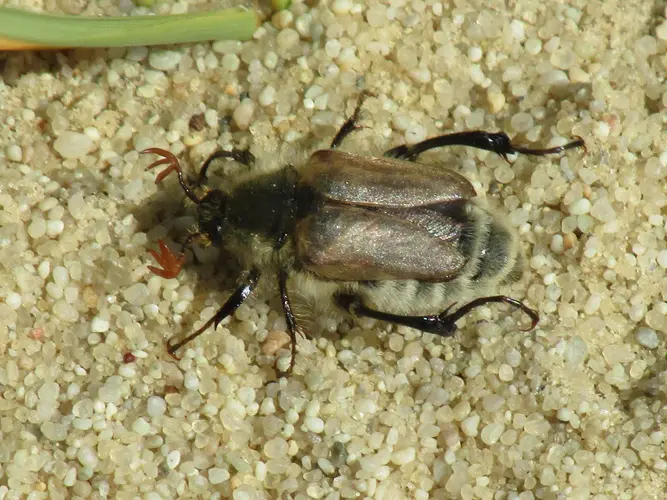
CHADRON – Dr. Mathew Brust, Chadron State College Professor of Life Sciences, returned to south-central Wyoming this summer in hopes of capturing additional specimens to confirm what he suspected was his discovery of a new species of bumblebee scarab beetle in July 2022.

On July 10, in the late afternoon, he drove about 27 miles northeast of Rawlins to the Ferris Dunes, the site of his initial discovery in 2022. The temperature was in the mid-80s, but the beetle he was seeking was not flying.

Brust said he spent the night in Rawlins and wondered if he was too early in the season. He questioned if he had gone the wrong time of day or if wind was a factor. He had only collected four beetles the year before but was confident he could find them again since he remembered seeing between eight and 40.

The next morning, he drove to the Seminoe Dunes about 15 miles southeast of the Ferris Dunes bolstered by the knowledge that the habitat was similar to the Ferris Dunes. Additionally, last year he had seen a photo of what seemed to be the same insect taken at the Seminoe Dunes and posted on the iNaturalist app.

Last year, he had seen the beetle among sparse grass areas in the morning, so he returned to the same type of habitat at the same time of day. He arrived about 8:15 a.m. and hiked for 15 minutes to his favorite dune top, which faces slightly east, an added bonus since he knew it would be first to warm up. Not much happened for about 15 minutes.

“But, from about 8:35 to 10 a.m. was madness. The beetles start showing up all over. Initially, they were like clumsy bumble bees. First one, then a second within two to three minutes. Then another within a minute. And then three or so in a minute. Soon, I was seeing anywhere from two to 10 flying at any given time,” Brust said.

Brust covered about 10 acres while collecting a large series of specimens and photographed more. In August, he sent the new series from the Seminoe Dunes to the Nebraska State Museum in Lincoln where Dr. Matt Paulsen will collaborate with other experts to develop and publish the species description. Paulsen already has Brust’s Ferris Dunes specimens from 2022. The series of specimens is necessary for the species to be formally described, Brust said.

The official description process involves many measurements and similar data gathering, likely various detailed drawings, followed by the writing of a manuscript that will be submitted to a suitable scientific journal for potential publication, according to Brust.

Artis sculpture donated to CSC

CHADRON – Chadron State College recently received a sculpture created by the late William Artis, who taught art at CSC from 1954 to 1964, thanks to Cathy Clary, of Pasco, Washington, who was honoring her late husband’s wishes. Clary delivered the clay bust to CSC officials in late August.

Clary, who works at Columbia Basin College, made the donation to fulfill the wishes of her husband and CSC alum, Morse Clary. The couple, married in 1967, has one son, Nate, who lives in Portland, Oregon, and one daughter, Nicole, who lives in Pasco.

The piece, approximately 24 inches tall and 12 inches wide, is titled Madonna and Child.

“It was so nice to deliver it in person. Everyone was so warm and welcoming,” she said. “Morse always spoke highly of CSC. I’m happy the sculpture has a good home and hope it inspires future students. More people will be able to see it and appreciate it this way. Morse reached so many students, just like William Artis did. It is kind of a beautiful full-circle connection that we could bring that piece back and have it represent his legacy.”

Clary said her husband spoke highly of Artis’ craftsmanship and was greatly influenced by him.

“William Artis taught his students they could be respected as artists if they followed the tenets of good craftsmanship. He was a fine example of an artist who showed the discipline needed for a creative life. He was a teacher and a wonderful mentor,” Clary said.

Provenance provided by Clary states the sculpture was created by Artis in 1960 or 1961 and was influenced by his experiences teaching on the Native American reservation at Pine Ridge, South Dakota.

Morse Clary purchased the sculpture from Robert Yost, also a CSC student, in 1968. Yost, the retired director of the Mohavi Museum of History and Art, gave several Artis pieces to the College before his death in 2022 in Kingman, Arizona, according to Chadron State Foundation CEO Ben Watson.

CSC Art Professor Laura Bentz said the donation of the clay sculpture by William Artis will be an excellent addition to the permanent collection that contains about a dozen works by the Harlem Renaissance artist.

“Having multiple pieces on display by such a prominent artist allows the students to see how an artist works with a particular subject matter using a variety of materials, and how the artist's treatment of the subject matter changes or evolves,” Bentz said.

Morse Clary’s formative years were spent in North Platte, Nebraska, exploring the land around the river and discovering fossils. In a memorial video, he said there was a beauty and a tension in the way the fossils were embedded in the clay together. Clary said his early interactions with nature weaved their way into his view of the world and the 300 wooden book sculptures he created during the height of his career.

After serving in the U.S. Army, Morse Clary returned to CSC to earn a teaching certificate in 1966.

He taught for 32 years including high school art and theatre in Crofton, Nebraska, and art at the former Hiram Scott College in Scottsbluff where he met his wife. He earned a Master of Fine Arts in Sculpture and Printmaking from the University of Idaho and continued his teaching career at Marietta College in Ohio and Columbia Basin College in Pasco, Washington.