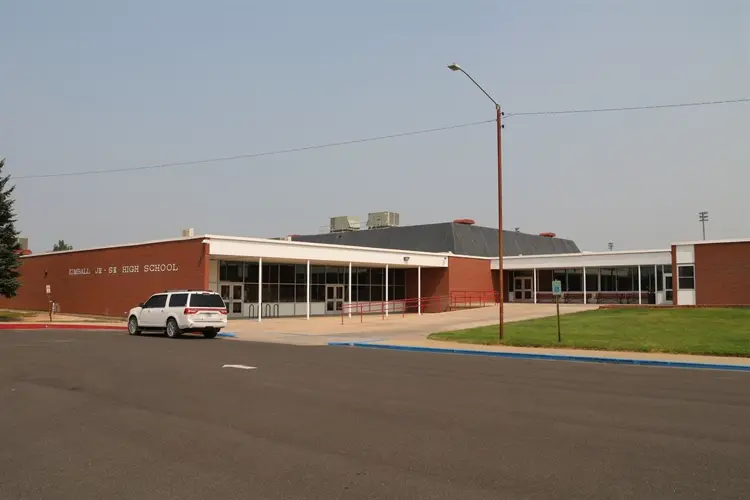
Kimball, Neb. — Growing up on a reservation in Montana, the career path for Tyse Rogers seemed obvious. Kids would turn 16, get their GEDs and go straight to work at the local lumberyard, joining their parents and neighbors at the biggest employer in town. 

Rogers took a different path. He went to college. Worked corporate jobs in Denver. Today, he's a career specialist teacher at Kimball Public Schools. He helps middle schoolers understand things like what jobs are out there, or what an electrician’s day looks like. He helps high schoolers plan out their life after graduation and makes them practice their public speaking skills. 

And he watches as students graduate and go on to work at nearby Clean Harbors, a company that incinerates thousands of tons of hazardous waste every year. 

Like the lumberyard near Rogers' hometown, Clean Harbors is the biggest employer in this small county in the southwest corner of Nebraska's Panhandle. For his students, going to work at Clean Harbors means getting to stay close to family. It means upward mobility at a growing company. And it means a starting salary upward of $50,000 — without needing a college degree. 

"It's good money out the gate. It's a good job," Rogers said. "We're not trying to push kids into college, and we're not trying to push them into trades. We're just trying to give them a view of everything and let them make the decision of what they want to do."

Plenty of Nebraskans have decided to attend college over the last 50 years: The number of Nebraska adults with a bachelor’s degree has increased significantly during that time.

But six of the state’s 93 counties have seen those numbers slide in the opposite direction between 2010 and 2020. Those counties are all in the state’s rural western half, far from Nebraska’s few educational hubs.

Of those six counties, Kimball County, population 3,434, had the lowest percentage of college grads in 2020. Only 13% of adults here have completed a four-year degree. 

The trends in Nebraska mirror those nationally — rural residents are still less likely to have a college degree than their urban counterparts.

The reasons for that gap are varied. The increasing cost of college has made trade schools and the workforce more lucrative options, Kimball teachers and students said. Most colleges are hundreds of miles away, and those who do earn a degree face limited job options back home. And rural Nebraskans are split on whether they have confidence in higher education institutions, a 2025 University of Nebraska poll of rural Nebraskans found.

Kids here do go to college. They go on to be nurses and teachers. They just don't always come back. 

***

It's the beginning of the school year, and the Kimball County High senior class is starting to think about college. Seated together in one classroom, the class of 25 weighs their options. 

They check off core college classes in dual-credit classes, free this year through the community college 45 minutes north in Scottsbluff. They go on college visits and take ACT prep classes. And they're thinking about how expensive — and far from home — college will be.

Kimball's college-going rate fluctuates from year to year, said Danielle Reader, principal at the high school for the last six years. When asked, nearly half of this year's senior class think college is the right fit for them. Last year, in a class of 18, five pursued college. There used to be a stigma around not going on to a four-year college, but the school doesn’t push “a college-for-everyone mentality,” Reader said. 

"We don't want students to go to college just to say they're in college without a plan. I always tell them you’re allowed to change your mind. And what we try and do here is prepare them so that they don’t close any doors before they know they want the door to be open."

Over the past 20 years, the average cost of tuition and fees at public four-year colleges has double, according to U.S. News and World Report. In Nebraska this year, the University of Nebraska system approved an average 5% tuition increase across its four campuses. 

The rising costs and likelihood of student debt have affected decisions and perceptions of college in rural Nebraska. In Kimball, Reader has seen more students pursue trade school.

A 2019 survey of rural Nebraskans found that six in 10 agreed that their education was worth the financial cost, according to the University of Nebraska’s annual Rural Poll. But seven in 10 of those surveyed didn’t think getting an education after high school was affordable for most people. More said that apprenticeships and trade schools should be promoted as an alternative to higher education. 

Nationally, trade school enrollment has increased by nearly 20% since 2020, totalling 871,000 students, according to the National Student Clearinghouse Research Center. 

“In western Nebraska, there are challenges filling current available jobs, and that becomes the most pressing matter,” said Josie Gatti Schafer, director of the Center for Public Affairs Research at the University of Nebraska at Omaha. “That’s probably where some of the ‘You don’t need a degree’ talk comes from. A lot of the jobs that are open and available in western Nebraska today may not need one.” 

Kimball grads go on to weld, drive semi-trucks or become linemen. For many, it’s a bigger bang for their buck, said Andrew Hunzeker, an outreach services manager for the Nebraska-based nonprofit EducationQuest Foundation. Even those who go straight to work at places like Clean Harbors can find themselves making a high salary out of high school. 

Students find themselves asking, “Why would I go to college and take out $32,000 in student loan debt when I could go and become a plumber and start making $60,000 minimum a year?” Hunzeker said. “They’re definitely going to find jobs in rural America, we still need all of those things.” 

Hunzeker spends most of the fall helping families in the Panhandle navigate college applications and the FAFSA, the federal application for financial aid. The students who do choose college, he said, are becoming increasingly aware of the limited job options in their communities.

“There are a ton of students going into health care, students going into education,” Hunzeker said. “What we are seeing more and more of is students who are taking the time to find jobs that are just needed in general.” 

Pair the cost of college with Kimball’s distance from other communities, and figuring out whether to go to college gets more complicated. 

Seated in the classroom, the Kimball seniors list off their college options. There are the University of Nebraska’s campuses in Kearney and Lincoln, both hundreds of miles to the east. Chadron State College, 150 miles north, just south of the South Dakota border. The schools across state lines in Colorado or Wyoming are all closer. But they’d all be more expensive than in-state tuition at a Nebraska college.

The average American student goes to college within 50 miles of their permanent address. The students in Kimball are effectively in a higher education desert. They can access associate degree programs at Western Nebraska Community College locations in Scottsbluff or Sidney. But they live beyond a reasonable commute to the closest four-year college.

Aside from Chadron, four-year institutions in Nebraska are consolidated in the east: in the Omaha and Lincoln metros, Peru, Kearney, Wayne, Fremont, Crete, Seward, Hastings and York.

There are more higher education deserts in the Midwest and Great Plains compared to the more densely populated coasts, something Paul Turman, chancellor of Nebraska’s state college system, saw firsthand last year. While at a meeting in North Carolina, Turman was shocked to learn that the state — two-thirds the size of Nebraska’s land mass — had 58 community colleges to Nebraska’s 21. 

“Go any direction in 15 miles, you’re going to find a community college (in North Carolina),” Turman said. “More students get degrees in that state simply because of geography.”

Nebraska's tuition reciprocity agreements largely leave western students out of the equation, too. The state has tuition discount agreements with Midwestern states like Missouri and Indiana to the east and Kansas to the south. But Wyoming, Colorado and South Dakota — all closer for students living in the Panhandle — are in a separate regional agreement that doesn't include Nebraska. 

Next year, the University of Wyoming does plan to offer a “good neighbor” discount — a $2,000 scholarship for an institution with a $22,000 annual tuition. 

“Students in these rural parts of the state need just as many opportunities as the students that are in Omaha and Lincoln,” Turman said. “Sending someone away to get their degree is only going to mean that you’re going to hollow out the Panhandle more than what it is now.” 

***

Kimball started with the railroad. 

By the late 1800s, the small settlement by the Union Pacific train tracks had grown to include a hotel, a newspaper and local businesses. Wheat and sugar beets had taken hold as the local crop. 

An oil boom in the 1950s brought hundreds of people to the area. Then in the ’60s, the construction of military missile silos throughout the Plains caused the population to swell again. 

The county's population peaked at 6,400 in the ’70s. It has since dwindled to nearly half of that. 

Today, there is no chamber of commerce in Kimball. The city's economic development job remains vacant. The area's biggest employers are Clean Harbors, security products manufacturer George Risk Industries, the hospital and the school district. 

"Outside of that, unless you want to open your own accounting practice or something like that, those would be pretty much the only ones where you have a degree that you come back to Kimball for," said Trevor Anderson, Kimball Public Schools superintendent. 

Long-term population loss can narrow the local economy, shrinking the types of jobs available in a community, said Don Macke, a Lincoln-based rural community development consultant. 

“You’ve got a little bit of industry, some ag, maybe a little bit of retail. But you’ve got fewer occupations that are attractive to people with a post-secondary education,” Macke said. “Unless there’s a real strong attachment that would bring somebody back, for most folks, there’s got to be an occupation that matches up with your career aspirations.”  

The big challenge for western Nebraska, Schafer said, is the fact that high school grads have to leave to get training for more specialized jobs. 

"Western Nebraska has a lot of health care jobs, jobs that might not require a bachelor's degree, but certainly require some training," Schafer said. "Do we have that training in the region? Because once people leave to get training … they might not come back to practice." 

The Nebraska Community Foundation's annual youth survey consistently finds that rural Nebraska kids want to move back to their hometown, or somewhere similar, after college. But more than half cite job opportunities elsewhere as the main reason why they wouldn't return to their hometown.  

Going away for college means making new friends and placing roots in a new city, Schafer said. Their professional connections grow. By graduation, they could be faced with picking between a job in their hometown or the same type of job in a bigger city with a higher salary. 

"It becomes harder to move back when you have that network somewhere else," Schafer said. "At the end of four years, they're going to have a choice.”

The Flatwater Free Press is Nebraska’s first independent, nonprofit newsroom focused on investigations and feature stories that matter.