
Lexington overwhelmed by tidal wave of need after Tyson closure
The local Community Foundation has paused its efforts to distribute aid money as funds dwindle
By Sara Gentzler
Flatwater Free Press
LEXINGTON — At 2 a.m. on a 16-degree mid-January Monday, Magdalena Barrios got in line. Only 10 people stood in front of her outside the Dawson County Opportunity Center.
By 5:30 a.m., the line wrapped halfway around the side of the former Walmart. The doors wouldn’t open until 9 a.m.
For years prior, the roughly 200 people in that line worked at Tyson Foods directly across the street. Their jobs were now casualties in that plant’s closure, and they were seeking help to pay for things like rent and groceries. The shutdown yanked 3,200 jobs from their community of about 10,000 people.
Seven hours after she got in line, Barrios finally got to the front. She walked away with a ticket, paperwork and the promise of a phone call from a nonprofit that could help with her utilities.
A week later, no one had called. She went to the fairgrounds, where organizers had moved operations to a spacious, heated building. The organizations helping with aid faced mounting backlogs, staff on-site explained. In just one day, the nonprofit handling utilities was getting requests from three times the number of people it usually helped in a month.
Regardless of the delay, Barrios was grateful that people were coming together to get her and others help.
“... There’s a lot of us,” Barrios said in Spanish through a translator. “I can’t say, you know, ‘You have to help me now,’ because I realize there’s a lot of people.”
After Tyson’s shutdown announcement, individuals and organizations rallied to raise about $300,000 to support laid-off workers. But within two weeks of starting to hand out aid, Lexington nonprofits were overwhelmed by the sheer volume of need. Money started running low. By the end of January, the relief fund stopped accepting new requests for aid.
Organizers expect a couple of big donations to come through soon, said Beth Roberts, executive director of the Lexington Community Foundation.
“We knew that the need was going to be great,” Roberts said. “We also know from talking to a lot of other communities who had dealt with similar closures or who had dealt with natural disasters that we had to be realistic and know that we can’t serve everyone.”
By 7:30 a.m. on Jan. 20, the day Tyson planned to wind down operations, another line formed outside the Opportunity Center that houses offices for services like unemployment, health and human services and the community college.
Many people in line wanted help applying for unemployment benefits, said Brent LeClair, regional reemployment services manager for the Nebraska Department of Labor.
It’s a daunting process that requires some tech know-how and a resume, and there’s a language barrier for some of the workers who were laid off.
LeClair estimated that his office helped 500 people over the first two days. They had tripled the number of employees available to help. Some laid-off Tyson workers still waited up to three hours. Department of Labor employees are also calling workers to offer help, according to a spokesperson, and more than 150 employers have been part of its job fairs and outreach efforts.
State data show that the number of initial unemployment claims filed statewide the week Tyson closed was 178% higher than the same week last year, and more than triple the number filed the week prior. Of that week’s 3,042 initial claims in Nebraska’s 93 counties, nearly half — some 1,419 — came from Dawson County.
“It’s pretty unprecedented,” LeClair said.
Other organizations have helped people with their unemployment claims, too, including at the public library. Rocio Casanova, a youth and family services librarian, said people came there with questions as soon as Tyson told its workers about the closure in November.
“They wanted to know: What’s going to happen after they close? Are they going to have other job opportunities available for me? What am I going to do with my 401(k)? What is going to happen with my house?” Casanova said.
She created a survey to understand their biggest concerns. Community leaders held a meeting and talked through needs. Some drafted a letter asking the area’s state senator, Sen. Teresa Ibach, to pass a state law governing mass layoffs. She has since introduced a similar bill.
Lutheran Family Services had lawyers give a presentation about workers’ rights. The library organized informational sessions about finances, saving money on energy bills, Medicaid and prescription costs.
The Lexington Community Foundation began collecting donations, creating a relief fund that has served as the main source of financial aid. As of Wednesday, the foundation had raised a total of $300,755, Roberts said. Split among Tyson’s 3,200 workers, that’s just under $95 per person.
The fund started doling out aid on Jan. 12. Once former Tyson workers made it through the line, volunteers at the Lexington Welcome Center asked questions to figure out which organizations were best suited to help meet their needs.
The Community Foundation allotted money to local organizations that could provide help directly: the local hospital for medical expenses, the nonprofit Micah’s House for housing costs and the nonprofit Community Action Partnership of Mid-Nebraska for help with utility bills. Volunteers also offered laid-off workers $20 grocery vouchers to the locally owned Plum Creek Market Place — one per person in the house.
“All four of those pieces were already things that were happening. We’re just funneling people to them,” said Riley Gruntorad, CEO of YMCA of the Prairie.
He was one of the people coordinating intake appointments when the lines for aid were longest.
“It was heartbreaking,” Gruntorad said. “It was emotional. I mean, I’ve … grown up here my whole life. That’s why we’re doing what we can.”
Volunteers started issuing appointment tickets a couple days in instead of having people wait hours. They planned for 15 to 20 appointments an hour, Roberts said.
But the number of people in need quickly outpaced the capacity of the aid organizations.
The Community Action Partnership’s Lexington office, tasked with handling utilities help, employs just one person. That’s usually enough to distribute a small amount of funding each month and run a food pantry, said Tammy Jeffs, community services director.
Jeffs, who is based in Kearney and supervises eight of the organization’s offices, said she and another staff member have been traveling to Lexington on alternating days to help.
The office also connected with the hospital’s translation service to help people create profiles to apply for unemployment, she said, and recruited bank employees to coach people on options to keep their homes.
Community Action Partnership’s lone employee in the area typically helps about 20 people a month with their utilities or other services and gives out 100 boxes of food, Jeffs said.
With the Tyson closure, intake volunteers were processing 60 applications for utility assistance a day, telling people that Community Action Partnership would call them.
“There is absolutely no way,” Jeffs said. “And we’ve complained about this. We said, ‘There’s absolutely no way (our employee) can call 60 people. You’re bottlenecking us.’”
People started lining up outside their building in the mornings. They got hundreds of phone messages. They kept running the food pantry, buying food in bulk through Plum Creek Market Place and giving out about 400 boxes of food in two weeks. They asked the Welcome Center to stop sending people, but the requests for aid kept coming as a waitlist formed.
Community Action Partnership has started referring people to a state-run program for utilities aid as they shift focus to just the food pantry, Jeffs said. If more money comes in through the relief fund, they’ll use it to help people who are already on their utilities waitlist.
There was a similar backlog at the nonprofit directing housing payment help, Roberts of the Community Foundation said.
No local agency could possibly have had the capacity to handle the onslaught, Jeffs said.
The one place set up to communicate with the thousands of employees speaking multiple languages — Tyson itself — has offered little help. The company could have helped people understand what to do with their retirement accounts, how to continue their insurance or helped them access pay stubs for unemployment applications, she said.
The company has offered support, a spokesperson said in an email, including by helping people apply for open positions at other Tyson locations and offering relocation benefits.
“Dawson and Buffalo County had those floods a couple years ago, and … it's very similar,” Jeffs said. “All you see is … all these people who need something, and they're looking to you to do it.”
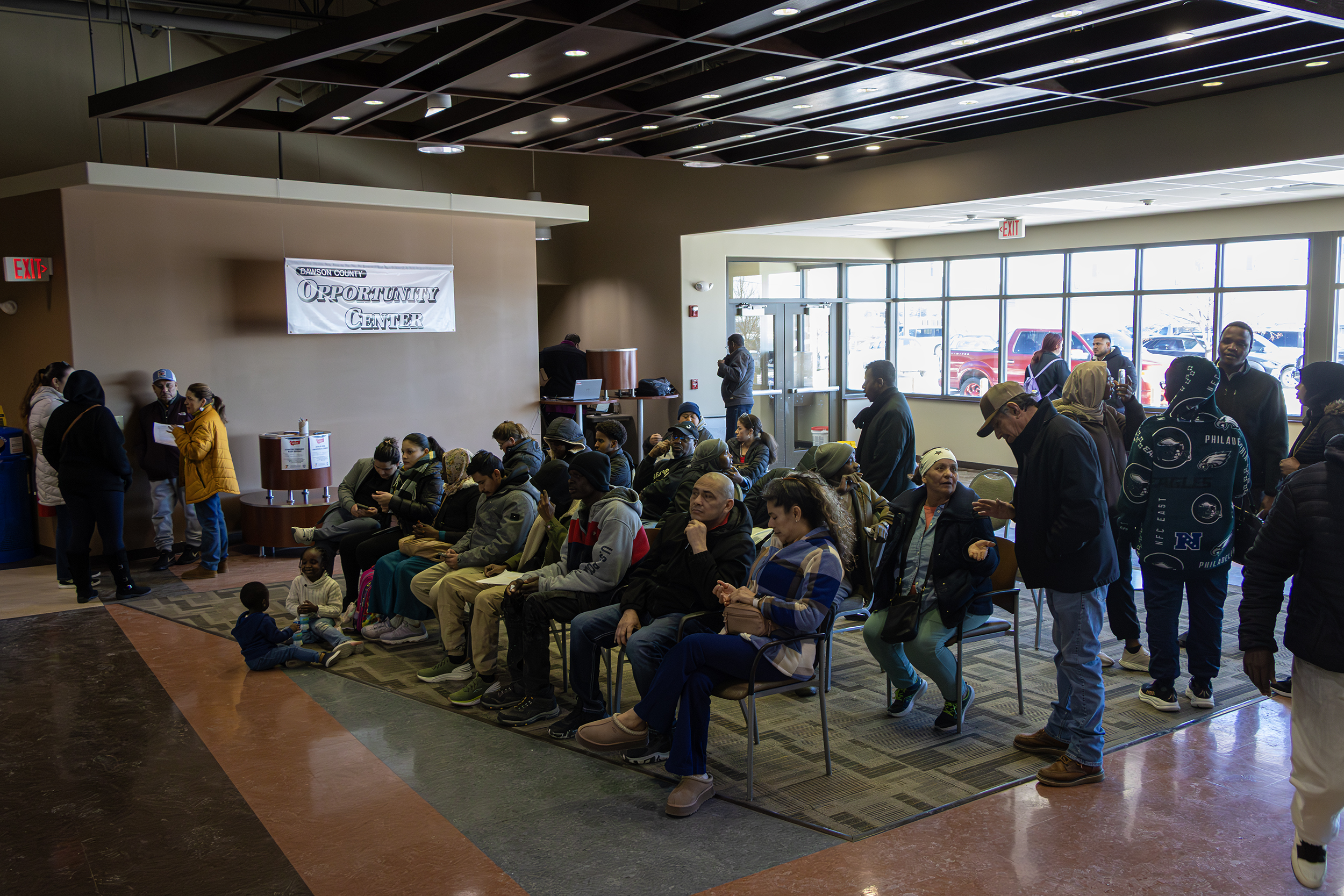
On Jan. 26, two weeks into distributing aid, the process felt well-oiled. People were now waiting in a heated building, with plenty of folding chairs to take a seat.
Magda Franco, who worked at Tyson for 15 years, showed up without an appointment ticket and waited only 40 minutes for help.
“If they’re able to give me half of the cost of my rent and my (utility) bills … I’m very thankful,” she said in Spanish through a translator.
At Plum Creek Market Place, store manager Carl Hays said about 75% of the grocery vouchers they had handed out had been cashed in.
People were coming and using them “almost immediately,” he said.
The community’s resources can’t match the magnitude of the jobs lost, he said.
“We're just putting a Band-Aid on a problem for now. But if it feeds families and kids for a couple of weeks, that at least gives them some time to figure something out,” he said.
By Jan. 27, the Community Foundation announced it was pausing intake appointments for people seeking help. After two weeks, the relief fund had only $77,928 left to work with, and a long waitlist.
“We really wanted to give all the entities that were involved time to catch up to be able to meet the needs of those that had already requested assistance,” Roberts said. They wanted to make sure that they weren’t wasting people’s time or “overextending.”
As of Wednesday, the Community Foundation had doled out $293,495 since Jan. 12 with the help of 23 volunteers. It had processed aid applications for 4,816 people, including both workers and everyone in their households, Roberts said.
A couple foundations that have chosen to remain anonymous have confirmed that donations are coming soon, Roberts said. She hopes that upcoming gifts will help them work through remaining intakes before shifting focus to just food and utilities help.
“It's shown a lot of hope-building in what we could do, but there's … there's a lot of healing that really needs to take place in our community right now,” Roberts said. “And sometimes that healing … doesn't always come with a dollar sign.”
The same people mobilizing to help have faced upheaval in their own jobs and lives as a result of the shutdown. Gruntorad said he has been fundraising for years to build an addition to the YMCA, and now that’s on hold. Hays said the grocery store has stopped hiring.
“We don't know what our world's gonna look like,” he said.
The last several weeks, librarian Casanova said, have brought an array of emotions: hope, anguish, gratitude.
Now, she’s noticing that the reality is setting in: People are deciding whether to stay or go.
“People have been doing the best they could to provide the resources, but at the same time — it’s a lot. It’s a lot of people,” Casanova said. “It’s 3,200 employees … It is complicated when the rent and the utility bills, especially being winter, and the cost of groceries are so high. You know, $300,000 is not going to go very far for 3,000 people and their families.”
The Flatwater Free Press is Nebraska’s first independent, nonprofit newsroom focused on investigations and feature stories that matter.